
These hastily-draw conclusions do not paint the whole picture.
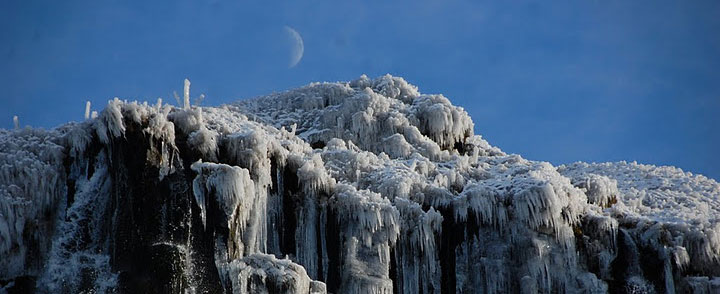
Iceland is certainly cold in winter months, but the famed landscape of eternal tundra is reflective of Greenland, not Iceland. Belief in mythological spirits certainly does exist, but Iceland is far from being an underdeveloped rural society of loons. The country’s most famous export, Björk, is considered unique by any standards. Her musical and aesthetic choices are hardly reflective of the conventional norms of the country, and your average Icelander is far from outlandish.
Björk’s recent accomplishments have taken the form of collaborative projects with musicians like Dirty Projectors and Antony And The Johnsons. Ostensibly, her solo career has been deferred, and to fill in the void, the world has shifted towards Iceland’s other successful musical acts. Few and far between, those acts have wielded tremendous power, their sheer dearth providing them the opportunity to mold global perspectives on Icelandic’s music scene.
Post-rock quintet Sigur Rós has, in the recent past, contributed to the rebranding of Iceland with a new visual and musical face — a move that has unwittingly opened the scene up to another slew of stereotypes and associations.
– Ólöf Arnalds

RELATED LINKS
MUSIC RESOURCES
GOGOYOKO
A music-sharing site used almost exclusively by Northern European musicians. Gogoyoko is all about Fair Play in music; users can buy music directly from musicians, and a portion of proceeds is donated to charity.
ICELAND MUSIC EXPORT
A comprehensive website which covers just about everything there is to know about Iceland's music scene.
ICELANDIC AIRWAVES
An annual music festival which features a variety of bands, mostly from Iceland, North America, and Northern European countries.
ICELANDIC MUSIC
A go-to music blog covering popular Icelandic musicians.
NORDIC MUSIC PRIZE
An annual, five-country award for best album of the year. Sigur Rós' frontman, Jónsi, won this year's prize, the first one ever.
THE REYKJAVIK GRAPEVINE
A publication that covers all aspects of Icelandic creative culture, and beyond.
REYKJAVIK TOURIST WEBSITE
Official tourism website, on year-round festivals. Of particular note are Culture Night (August) and Icelandic Airwaves (October).
RECORD STORES IN REYKJAVIK
12 TÓNAR
Skólavörðustígurm, Reykjavik, 511-5656
SKÍFAN
Kringlan 4-12, Reykjavík 591-5300
SMEKKLLEYSA
Laugavegi 28, Reykjavík
MUSIC VENUES IN REYKJAVIK
FAKTORÝ BAR
Smiðjustígur 6, Reykjavík 101
HARPA
Austurstræti 17, Post office box 709 , Reykjavík 101
HEMMI OG VALDI
Laugavegur 21, Reykjavík 101
KAFFIBARINN
Bergstaðastræti 1, Reykjavik 101
NASA
Vallarstræti, Reykjavik 101, 511-1313
SÓDÓMA
Tryggvagata 22, Reykjavík
ICELANDIC RECORD LABELS
12 TÓNAR
ATA DIGITAL
BEDROOM COMMUNITY
BRAK RECORDS
CHING CHING BLING BLING
ERASED TAPES
HLJÓÐAKLETTAR
KIMI RECORDS
MORR MUSIC
RECORD RECORDS
SKAKKAPOPP
SMEKKLLEYSA
WEIRDCORE
MUSICIANS IN THIS ARTICLE
AMIINA
CATERPILLARMEN
DAD ROCKS!
DANÍEL BJARNASON
LJÓSVAKI
MUGISON
MÚM
ÓLÖF ARNALDS
MY SUMMER AS A SALVATION SOLDIER
PÉTUR BEN
RABBI BANANAS
RÖKKURRÓ
SEABEAR
SIGUR RÓS
SIN FANG
SKETCHES FOR ALBINOS
ÞÓRIR GEORG
YODA REMOTE
Mother Nature’s Role
Talk to any Icelandic musician, and one will discover that this assumption is met with great skepticism and often, cynicism. Yes, Icelandic musicians are influenced by their environment, but what defines their environment is much more than a series of breathtaking postcards or video clips one might see on Planet Earth. To pigeonhole all Icelandic music as a living soundtrack for pondering life’s great mysteries would be foolish and inaccurate.
“There are a lot of bigger factors involved,” says Matthew Collings, of the ambient electronic project, Sketches For Albinos. He lists isolation, weather, a small population, and attitude as factors that he feels play a more transformative role than natural beauty. “I think [nature] simply gives you a sense of scale — that you are tiny, and therefore, not limited by anything else… [but] not all music is Iceland sounds like Sigur Rós and is quite the opposite of what you’d expect people to make staring out of the window, looking at mountains.”
With two-thirds of the country’s population living in the greater Reykjavik area, most Icelandic musicians are accustomed to city life more than anything else. Life is not spent herding sheep, breeding horses, or reading by candlelight; flats are shared with relatives and friends and powered by first-rate geothermal energy. Weekends are generally spent partying until the wee hours of dawn and soaking up the city’s infamous nightlife, not watching puffins mate on the Northwest coast. So, while Reykjavik is but a skip and hop away from the oldest geyser in the known world and the marvelous Blue Lagoon, the general consensus in the music scene is that nature’s influence is overstated.
“Just as in any other city, our everyday life is just that: everyday life,” says Árni Þór Árnason, guitarist and bassist of the indie rock band Rökkurró. “This might be a different story if you talk to a band that´s from the countryside, but all of us in Rökkurró live in Reykjavík and have been ‘city kids’ most of our lives.”
Perhaps, then, influences stemming from city life play the most impactful role. It all begins early on, in homes, schools, and communities.
“There are both art and music classes in the schools. And it’s pretty common that kids study music,” says Rúnar Magnússon, founder of Hljóðaklettar, a small boutique label which focuses on experimental music. “Storytelling used to be a big part of Icelandic daily life, as entertainment in the home… it’s kind of a very old thing to be doing this — writing stories and performing them in some way.”
Sindri Már Sigfússon, of Seabear, also attributes his creative success to an encouraging home environment. “When I was like 9 [or] 10, I told my family and grandparents I was going to be a painter, and they were very happy with that…” he recalls. “I think it’s more of some sort of ‘Icelandic spirit’ that pushes a lot of bands — a ‘work hard and do your best’ kind of feeling.”
SAMPLE TRACKS Bloodgroup – “My Arms” (Self-Released) Who Knew – “Tranquility” (DevilDuck / 101 Berlin) Pornopop – “Little Kafka” (Ching Ching Bling Bling)
DOWNLOAD / STREAM COMPLETE MIXTAPE
– Árni Þór Árnason, of Rökkurró
A Country In Musical Infancy
Conductor and composer Daníel Bjarnason is a world-class musician known for pursuing classical music with an experimental bent. He describes the country’s musical infancy, saying, “There was no playing of instruments to speak of in Iceland, until the last century, and our musical history is very short. In some ways, I think this is a good thing, because we are not weighed down by it, and we don’t feel that we need to continue any tradition of a certain music. So, there is freedom!”
Historically, much of Iceland’s folk music is associated with religion. As with most Nordic countries, though, the population of Iceland in the 21st century is fairly secular. A study conducted by sociologist Paul Froese in 2001 identifies 23% of the island’s inhabitants as either agnostic or atheist. Yet choirs are present in schools, churches, and communities, but the relationship of folk music and churches seems to persist more out of habit than religious devotion.
“You don’t have to be very religious to be singing in a church choir…” says Magnússon, of Hljóðaklettar. “It’s more of a cultural thing.”
Much of Iceland’s creative history can also be attributed to written works. Though it is often assumed that Old Norse literature comes from Norway, most was actually first documented in Iceland and date as far back as the 13th century. In the 14th century came a series of traditional rhyming poems, known as rímur. Much like the relationship between singing and churches, these alliterative, metered poetic verses maintain a level of symbolic cultural importance to this day.
“There is still a choir that sings traditional rímur. And if you’ve seen the Sigur Rós DVD, Heima, you can see Steindór Andersen performing a couple of them, along with the band playing, ” says Snævar Albertsson, who produces music under the moniker, DAD ROCKS!. “But, in general, it’s not a very overt source of inspiration, but more a point of common cultural identification.”
– Pétur Ben
A Culture Of Collaboration
“I think it’s all about inspiration from one another,” says Albertsson. “There is a very bonded music community in Iceland, and I think that it’s obvious that these bands start to inspire each other.”
The scene is small, but its vibrancy offers immense potential for collaboration. The verity of this is echoed time and time again, by musicians of all kinds — from the indie rock stalwarts, as one might expect, to the garage rock nobodies who have barely seen their music exported outside of the country. Show bills on any given night might feature bands of three or four varying genres of music, the only connection being that they are simply friends who want to play a show together.
“Everyone goes to the same places, plays the same clubs, and get wasted at the same after-parties…” says indie singer-songwriter Pétur Ben. He explains that the community rewards those with good attitudes and sincere spirits. “First, you need to look at what you can do to help, and the community responds accordingly.”
“I’ve got a lot of friends here who are involved in music, and they’re always more than happy to help out and give out tips and pointers, although they’re making entirely different music from me,” explains Geir Helgi Birgisson. He explores a hardware-heavy variety of electronic music called Skweee and creates under the moniker, Rabbi Bananas. “People here tend to be adventurous; there’s a lot of different styles going on, so the community has a large variety of directions.”
“There is competition and there are cliques, like in every scene, but everyone helps everyone out…” says Collings. “It’s such a small place that if you go around acting like an arrogant rockstar, then everyone will despise you, and no one will respect or help you or what you are doing.”
Ukulele-wielding songbird, Ólöf Arnalds, seconds this fact, saying, “Everyone knows everyone here. If you meet someone new, it usually takes less than a minute to find a link to that person.”
But according to Bragi Marinósson and Emil Svavarsson of the electropop band Yoda Remote, a small music community can be a blessing and a curse. “It’s easy to get noticed,” says Svavarsson, while Marinósson adds, “but because of the small size, it’s hard to get attention if the music is not very different from the music that’s already there.”
“You don’t get away with doing something that’s not original,” Svavarsson concurs.
“Everyone feels they have to contribute something unique, compared to some places in the world where… [if there is] a band that’s unique, it’s okay in that town [to] have two thousand of exactly the same band singing about… exactly the same stuff,” muses solo artist Mugison. “Over here, that’s nearly impossible… Even though we’re definitely all copying from all sort of places, there’s kind of a mix, which turns unique.
“Say, somebody is copying me… and they release a song,” he continues. “I think the chances are that, within one week of them releasing the song, they’ll run into me in Reykjavik, or at some place, some venue, some street… and they’ll feel awkward, because they know everybody, who’s saying, ‘Hey, you’ve got that same sound as him; you’re just copying him…’ And that’s kind of nice, because then you’re forced to at least try to make your own voice.”
SAMPLE TRACKS
DOWNLOAD / STREAM COMPLETE MIXTAPE
Rökkurró – Augun Opnast (12 Tónar)
Seabear – “Lion Face Boy” (Morr Music)
Daníel Bjarnason – “Bow To String I. – Sorrow Conquers Happiness” (Bedroom Community)
SAMPLE TRACKS
DOWNLOAD / STREAM COMPLETE MIXTAPE
Ólöf Arnalds – “Innundir Skinni”
Pétur Ben – “Something Radical” (12 Tónar)
Lay Low – “Why Do I Worry”
– Baldvin Esra, label manager at Kimi Records
Challenges Ahead
Between 2008 and 2010, Iceland experienced a short but extreme economic recession. Three of the country’s major commercial banks collapsed, and the Icelandic government had to turn to other countries for economic alleviation. According to Jon Danielsson, an associate professor of finance at the London School of Economics, “No Western country has crashed in peacetime as quickly and as badly.”
“Ordinary people are struggling,” says Magnússon, about post-recession life. “And there has been a change of atmosphere, which is great… people are not talking about stocks and sponsors over dinner now, and things don´t have to be so fancy. There is a rawness that is back.”
The crash has changed the average Icelander’s relationship to money, which in turn has impacted the music scene. Largely centered around self-releases and record labels run by musicians, pursuing a musical career in Iceland is a DIY affair of passion.
“A few years back, there was lot of money around; there was absolutely no event made there without a major sponsor — a bank or something. It was kind of obscene. All this capital is, of course, gone now after everything crashed…” Magnússon continues. “If I wanted to get a bunch of money, I wouldn´t be doing what I do.”
“Very, very few musicians can live off their work, and there is not a lot of money involved in the business,” admits Baldvin Esra, label manager at Kimi Records. Esra’s testimony is especially telling, as Kimi Records, along with its sister label Brak, is one of Iceland’s most successful boutique labels.
Most musicians see little payment for playing shows. Zakarias Gunnarsson, of the experimental rock group, Caterpillarmen, questions the scene with honesty, rhetorically asking, “[You] basically never [get] paid for your effort, and sometimes [don't even get] any fucking beer… How weak is that?”
Reykjavik is also plagued with a lack of proper music venues — a wonder, considering the prevalence of musicians.
“It can get a little tiring that there are only two or three venues you can play on a regular basis,” says Árni Þór Árnason, of Rökkurró. “The other venues are so much bigger that they are only used for special occasions.”
“Sadly, there are no city-sponsored music venues like in other Nordic countries,” says Sindri Már Sigfússon, “The venues sometimes close down until someone brave enough opens them up again.”
Iceland’s geography also adds another layer of complexity. Touring is difficult, and attaining equipment can be expensive.
“The fact that you can’t really tour Iceland and you can’t really sell records here [is] always going to [make it] almost impossible for bands to achieve any great commercial success,” explains singer-songwriter Þórir Georg, also known as My Summer As A Salvation Soldier.
“It’s an uphill battle Icelandic musicians face that bands in most of the other [countries] do not have to deal with. It’s not like we can just load up a bus and hit the road,” quips Leifur Eirksson, an experimental electronic pop musician known as Ljósvaki. “Well, there is a ship, but it takes days, and when you have to be at work next Monday because music isn’t earning you a living, it’s a bit of a Catch-22.”
Eirksson’s thoughts echo those of most Icelandic musicians, and complaints are few. Nearly everyone agrees that the Icelandic music scene is remarkable, and one to be treasured.
“There’s a lot of good music being made here, and some very competent studios recording it,” Eirksson continues. “We have something unique to offer and add to the musical experience of the world.”
“The variety in the Icelandic music scene is as diverse as any other,” says Snævar Albertsson of DAD ROCKS!. “But somehow the more bittersweet music has been doing well internationally.”
END
“I can’t say for my sake that Geysir or Gullfoss has inspired me, in particular, although I bet there have been written a thousand songs about them. Then again, I have lived here for most of my life so I can’t really say. It’s like being a fish and getting asked how wet feels for me. I don’t know because I don’t have any contrast to really understand it…
“I don’t think that is important, though. The product of the inspiration, I feel, is more important than the reasons behind it. And spreading the inspiration is like an invisible force that moves people and makes things happen. Doesn’t matter why or how, but it matters that it’s there.”
– Leifur Eirksson, of Ljósvaki